


After the stage falls: Reimagining Sudanese theatre in exile
Updated: Sep 6
By Khadiga Mustafa | OMC 2026
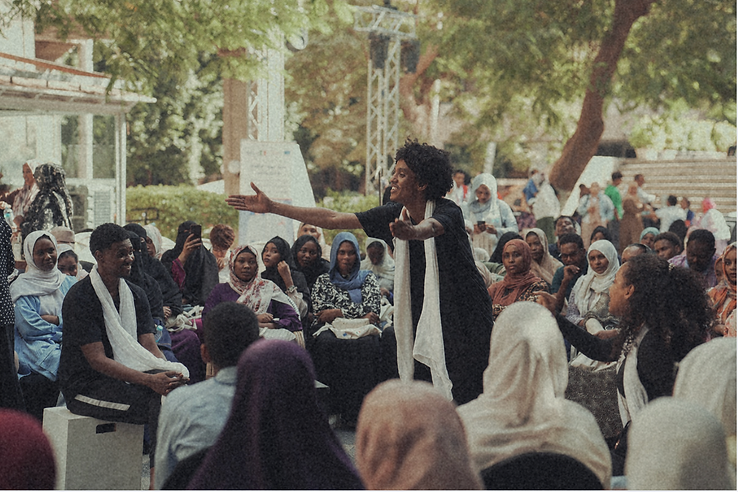
When the war reached Khartoum in 2023, the first things to fall were the spaces that held people together. Theatres closed, cultural centres emptied, and the stages that once carried Sudan’s collective voice were left in ruins. For many artists, the collapse of these spaces was a rupture in memory itself - a break in the continuity of a cultural practice that had always relied on presence, gathering, and the shared experience of performance.
Sudanese theatre has long been intertwined with the country’s political and social transformations. Emerging in the early twentieth century in Omdurman and Khartoum, it grew out of school stages, cultural associations, and the rich oral traditions of storytelling and song. As the national movement expanded, theatre became a space where realism could expose the tensions shaping Sudanese society. The performing body stood at the centre of this practice - a vessel carrying memory, history, and the lived realities of ordinary people.
As a cultural anthropologist, I have always approached Sudanese theatre as a living archive. The body, in performance, becomes a site where memory is stored, reshaped, and transmitted. This perspective echoes the work of Sudanese and international scholars: Ahmed Al‑Sadiq describes performance as a cultural act that reshapes the body within the space of the stage, while Sondra Hale highlights how women use performance as resistance in contexts of war and displacement. Their insights help illuminate the shifts that occurred after 2018, when theatre became visible during the revolution, moved online during the pandemic, and then faced collapse with the outbreak of war.
The destruction of cultural infrastructure forced artists to rethink how theatre could exist without a stage. In this landscape, monodrama - a form centred on the expressive capacity of a single body - became increasingly prominent. With limited resources, shrinking spaces, and dispersed communities, the individual performer emerged as a carrier of meaning. The body became the archive, the stage, and the memory.
This transformation is visible in the work of Sudanese artists now living in Egypt, Uganda, Kenya, and beyond. Among these initiatives, Thaqira Muthaqaba (“Perforated Memory”) stands out as a powerful attempt to rebuild theatrical language in exile. Created in Cairo in 2024 under the direction of Jasoor Abu Al‑Qasim, the performance brings together a group of Sudanese actors who found themselves displaced by war yet determined to continue creating.

The performance begins with silence - a long, deliberate silence that stretches across the stage. The actors move hesitantly, as if testing the ground beneath them. Their gestures are incomplete, interrupted, fragile. This aesthetic reflects the fractured experience of displacement, where memory is carried in fragments rather than in a continuous line. Movement becomes a way of remembering, and silence becomes a space where absence is felt.
In this sense, Thaqira Muthaqaba aligns with Diana Taylor’s concept of the repertoire, where knowledge is transmitted through embodied practice rather than written documentation. The performance presents memory as something perforated: full of gaps, pauses, and interruptions. The body becomes a site where these ruptures are expressed.
Although the production involves an ensemble, its aesthetic logic draws heavily on the principles of solo performance. Each actor carries their own archive, shaped by their personal experience of war, displacement, and loss. Even when they move together, the sense of fragmentation remains. The collective becomes a constellation of individual bodies, each holding a different piece of the story.
The performance also reflects a broader shift in Sudanese theatre in the diaspora. With the collapse of institutional spaces, artists have had to rely on improvisation, collaboration, and the emotional labour of rebuilding community. Theatre has become a way of asserting cultural presence despite the loss of place. It offers a temporary home: a space where belonging can be felt, even if only for the duration of a performance.
This transformation was visible when Thaqira Muthaqaba travelled to Egypt to participate in the Minya International Theatre Festival. The production represented Sudan in the category of non-traditional spaces and won two awards: Best Music for composer Omar Hamida and a Special Acting Award for actress Seza Surkati. The recognition affirmed that Sudanese theatre continues to exist, even when its physical foundations have been destroyed.
The contrast between the Cairo stage and the destroyed theatres of Khartoum is stark. It is a reminder of what has been lost, and also of what artists continue to rebuild through their bodies, their voices, and their presence.
In exile, Sudanese theatre is becoming something new. It is quieter, more intimate, more dependent on the body as a site of memory. It carries the imprint of rupture and the possibility of reconstruction. Through movement and silence, artists are creating an alternative archive: one that preserves Sudanese subjectivity outside the homeland and imagines a future where the stage can rise again.
Thaqira Muthaqaba is a gesture of survival. It shows how theatre can continue after the stage falls, how memory can be re‑imagined through the body, and how displaced artists can rebuild cultural meaning even in the absence of place. In doing so, it offers a glimpse into the future of Sudanese theatre; a future shaped by resilience, creativity, and the enduring power of performance.


Khadiga Mustafa
Khadiga is a Sudanese cultural anthropologist whose work explores performance, memory, and everyday cultural practices in contexts of displacement. She focuses on how bodies carry and reconstruct cultural meaning through movement and ritual, drawing on her background in anthropology and her engagement with Sudanese theatre in exile. She is based in Berlin and collaborates with artists and cultural institutions across Sudan and the diaspora.


Comments