


The taste of falafel
By Anonymous | ISSUE 28
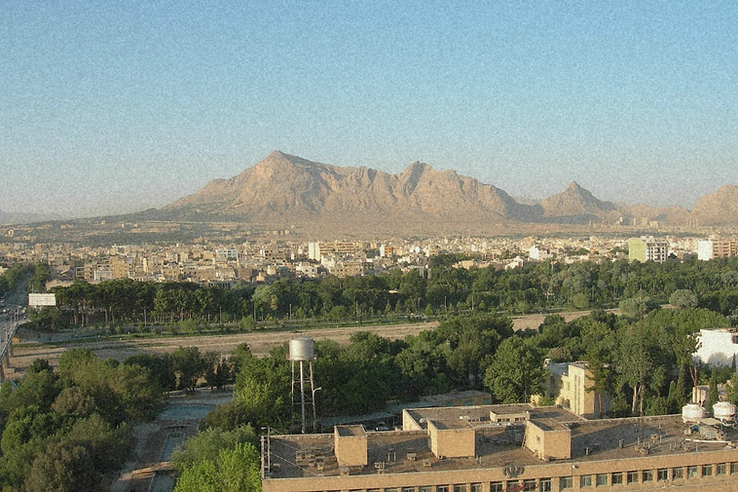
Forty years ago, a boy ate falafel in his hometown in Kerman province in southeast Iran. This was a food he had never seen before in Kerman. There were Arabic signs, food and people around him. None of this existed before. His community looked different, and it was evolving rapidly around him.
It was the year before he turned sixteen. Soon, he would be sent to war, far away from home. He had already been trained to shoot.
This boy was my father. It was 1987.
This piece provides a gateway to further analysis and documentation of individual experiences and histories of ordinary people during the Iran-Iraq War, a particularly brutal conflict in Iranian contemporary history that lasted from 1980 to 1988.
I learned about the Iran-Iraq war in a political science class at university. My mom had mentioned it as a foundational part of her childhood, without providing details. I was relieved to have approached the topic in academia, believing it would bring clarity about my family's history, and perhaps a sense of rootedness.
I was disquieted by the cold language used by International Relations of the Middle East (2024) to describe Saddam Hussein and Rouhollah Khomeini's intense rivalry, chemical weaponry, mass casualties, and Iranian global alienation. Women, children, migrants and internal displacement in either countries were not mentioned.
Is this education enough?
I grappled with understanding that my immediate family lived through the intense violence of war barely a generation ago. An uncomfortable truth dawned upon me: not only was I unaware of the experiences of my family, but my initial exposure to it was disconnected from Iranian humanity.
Thus, I began an archival project that reclaimed space not given to my family in historical records. With their permission, and using oral history as my methodology, I engaged in a three-part interviewing process with my father and grandmother to learn about their communities during the war.
I also acknowledge that I am not an apolitical force in conducting oral history, rather: the act of archiving has implications, none of which are impartial. This archive is not fixed, nor does it represent all Iranians.
My father was eight years old when the war began. Due to Kerman's physical distance from the Western border, it was never subject to ground conflict or air raids during the war. Nonetheless, a ripple effect washed over the province, reflecting deep internal and external changes in broader Iranian society. Kerman experienced an influx of migrants from the west of Iran, their population increasing by 9.76% during 1976-82.
War migrants were relocated and integrated into Kerman's school systems. The children became my father’s classmates and friends. When asked if he knew if the migration was temporary or permanent, he responded ‘most stayed, especially those from Khuzestan, they lost their homes — they had lost everything’. My dad recounted how Kerman, a province which typically did not receive migrants, experienced a culture shock.
Some migrants settled in an area referred to as poonsad dargah. Their community rapidly grew into a larger settlement, and it remains a neighborhood in Kerman today. The migrants' culture and language followed them. Primarily Arabic speakers, they set up shops, street signs and businesses in Arabic, which was unusual in Kerman at that time.
My dad recalled “The first time I ate falafel was at a small stand in the Arab settlements, it was delicious…. My uncle bought me a falafel sandwich. It was a very special moment, I will never forget this memory”. This is a unique illustration of the role of universal cultural elements, such as food , facilitating the creation of new community spaces.
My father recalled those years with clarity. His retelling helped situate a fraction of the notable displacement patterns that took place during the war. Furthermore, it allows deeper insight into the evolving nature of urban spaces in times of conflict and internal displacement.
My grandmother was 28 when the war started. A teacher by profession, she received training in first aid and basic military skills. ‘We adopted these roles, not just out of survival; but because we believed we had to do it for our vatan (country)’. For her, the war’s effects were in constant flux, having the ability to ‘bring people together and then pulling them apart, depending on if you got food or not’. People, she told me, were close in that they shared the same environment and necessities, but ‘there was so much expectation to host or be a happy family, we socialised out of a place of need’. Her story highlights how community relations were dictated by means of survival and necessity.
Both my father and grandmother vividly describe an inescapable sense of sadness, and a constant state of terror over conscription and losing their children in battle. My dad recalled losing one of his close friends to the war.
As a schoolteacher, my grandmother encountered these conscription efforts frequently: ‘Since the government declared children did not need parents' permission to join, every morning on my way to school, I would see military buses parked outside schools, trying to recruit children towards the war effort…..As a mother of two boys, I was petrified. I realised quickly that through songs of glory and sacrifice they (the government) were deceiving kids and luring them to conscription.’
My father recalls sharing this fear with his mom, who forced him to repeat a grade so that he appeared younger – delaying what seemed to be the inevitable. I discovered during the interview that the military took my dad to a training camp when he was 15. There, he learned to use various machine guns and weapons to prepare them for the battlefield. They were systematically coerced, subjected to intense propaganda, and exposed to violent imagery. ‘The duration of the camp was ten days, we lived in tents with up to 10–15 boys and my parents would come visit me with food.’
I asked my grandmother how she felt during this time. ‘I was very worried, even in these camps there was a risk of death.’ My dad interjected: ‘I remember one of the boys did not know his gun was loaded. He was lucky that when we were shooting he was pointing his gun towards the sky or he could've killed one of us. When he realised what could have been, he dropped the gun and began crying.’
The only reason my dad was not sent to the front was that the war ended.
Conclusion
My participants spoke of community fragmentation on a local level, connecting to larger, national-scale conflict that deeply harmed Iranian society. They recalled moments with children, food shortages, coercive military tactics and even executions. These critical details are noticeably absent in almost any descriptions of the war I've studied.
What is my role in my family's history as I sit thousands of miles away, if not to write it down?
I have used oral history to show how Kerman became the site of rapid changes as displaced migrants from the Western borders arrived. Social pressures were high, through systemic and coercive enlistment of young men into training camps by revolutionary guards.
These are stories of my family members, living through a conflict that profoundly changed the course of their lives. By making this work known, I hope to share a more nuanced and first-person perspective on a conflict that changed the fabric of Iranian society.


Comments